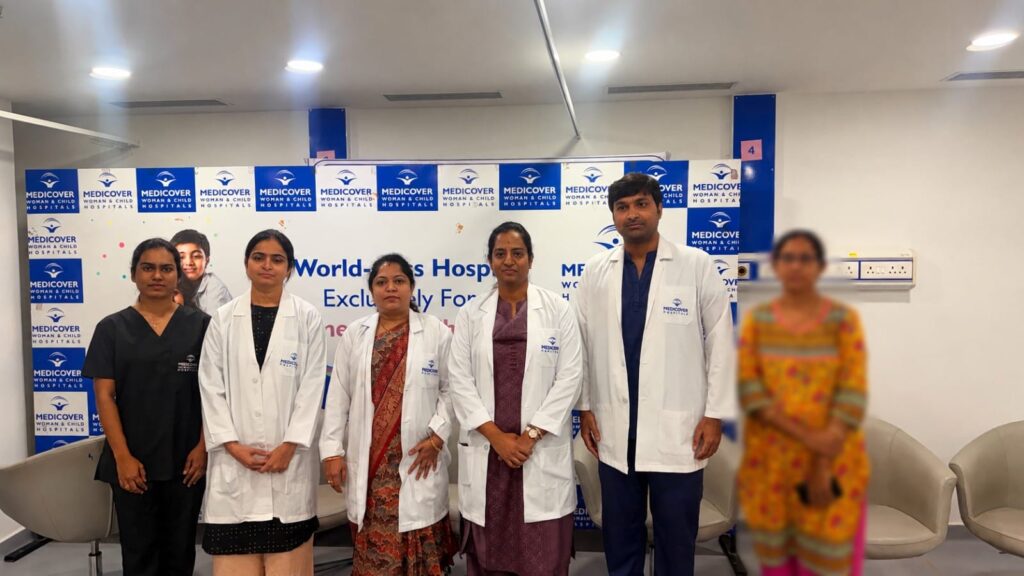
Hyderabad, 29th July, 2026: Doctors at Medicover Woman & Child Hospital, HITEC City, successfully treated a 41-year-old woman suffering from life-threatening vaginal bleeding caused by a rare vaginal hemangioma—a benign tumour of blood vessels in the genital tract—using an advanced image-guided minimally invasive embolisation procedure, avoiding the need for major surgery.
The patient was admitted with profuse vaginal bleeding and severe blood loss. Following a detailed clinical evaluation, doctors diagnosed the bleeding to be caused by a vaginal hemangioma, an extremely rare vascular tumour that can lead to sudden and potentially fatal haemorrhage if not treated promptly.
Due to the significant blood loss, the patient was first stabilised with blood transfusions and intensive medical care. Once her condition improved, the multidisciplinary team performed uterine artery and vaginal artery embolisation, a minimally invasive image-guided procedure in which tiny catheters are used to selectively block the blood vessels supplying the tumour. The procedure successfully controlled the bleeding without the need for open surgery. The patient recovered well and is currently in stable condition.
The complex case was jointly managed by Dr. T. Raghu Thejaswi, Consultant Obstetrician, Gynaecologist & Laparoscopic Surgeon, Dr. J. Shalini Narayan, Consultant Obstetrician & Gynaecologist, Laparoscopic Surgeon, and Dr. Saiteja Namala, Interventional Radiologist.
Dr. T. Raghu Thejaswi said, “Vaginal hemangioma is an extremely rare condition and can become life-threatening because it often presents as severe bleeding. Our immediate priority was to stabilise the patient with blood transfusions and then treat the source of bleeding through the least invasive approach. The close collaboration with our Interventional Radiology team helped us achieve an excellent outcome while avoiding major surgery.”
Dr. J. Shalini Narayan added, “Early diagnosis and timely multidisciplinary intervention are crucial in managing such rare and high-risk gynaecological emergencies. By combining expertise in gynaecology and minimally invasive techniques, we were able to provide safe, effective treatment and ensure a faster recovery for the patient.”
Dr. Saiteja Namala, Consultant Interventional Radiologist, said:
“Interventional Radiology plays a pivotal role in the management of life-threatening bleeding by offering precise, image-guided, minimally invasive treatments. Using advanced catheter-based techniques, we were able to selectively embolise the uterine and vaginal arteries supplying the haemangioma, achieving immediate control of haemorrhage while preserving surrounding healthy tissues. Such procedures avoid major surgery, reduce blood loss, minimise complications, shorten hospital stay, and enable faster recovery. This case highlights how Interventional Radiology has become an indispensable specialty in the management of complex vascular and gynaecological emergencies, working seamlessly alongside other clinical specialties to provide the best possible patient outcomes.”
This successful case highlights the importance of multidisciplinary collaboration between Gynaecology and Interventional Radiology, enabling complex and life-threatening conditions to be managed through advanced, minimally invasive techniques while ensuring better patient outcomes and faster recovery.